

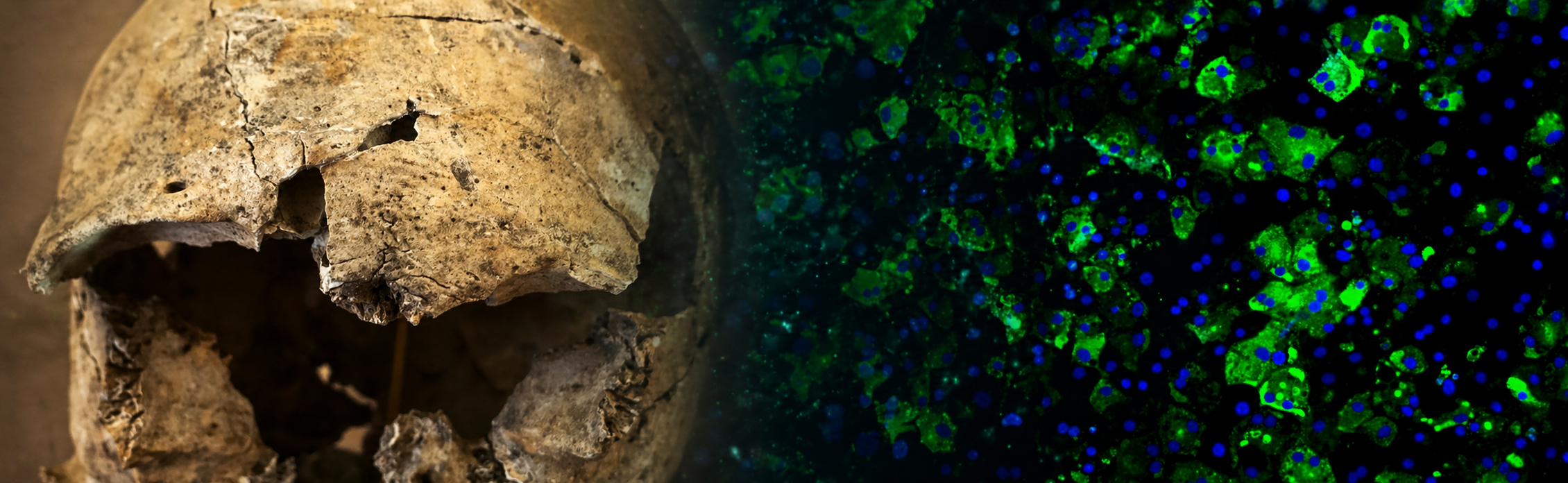
—Exploring the Liver of the Jomon People—

Project Leader
Hiroki Oota
Professor, Department of Biological Sciences
Graduate School of Science
From ancient genomes to understanding the constitution of present-day Japanese people.
This research experimentally elucidates the adaptive evolution of the Jomon people through iPS cells and genome science.
About the Project
Our research team has been sequencing and analyzing Jomon genomes. Analyses to date have shown that the Jomon belonged to an ancient lineage among human populations in eastern Eurasia, and that after reaching the Japanese archipelago during the Ice Age, they followed a long and distinctive historical trajectory as the archipelago became geographically separated from the continent.
We have extracted DNA from many Jomon human skeletal remains and have advanced whole-genome sequencing and large-scale computational analyses. As a result, we are beginning to see, little by little, what kinds of physiological traits the Jomon may have had. Genomic information has revealed features related to
lipid metabolism and alcohol metabolism, for example, which are also relevant to understanding the constitution of present-day Japanese people.
The genomes of present-day Japanese people contain a certain proportion of DNA inherited from the Jomon. In other words, understanding how each of us has inherited Jomon-derived genomic segments is an important clue for understanding genetic differences between individuals today.
Understanding the Jomon Genome as Cellular Function
However, reading genome sequences alone does not reveal how such differences appear as functional differences within cells. We are therefore producing induced pluripotent stem cells (iPS cells) from the cells of present-day Japanese people who carry relatively high proportions of Jomon genome segments, as well as from those who carry lower proportions, and then inducing these iPS cells to differentiate into cells resembling hepatocytes.
The liver is an organ involved in complex physiological traits such as lipid metabolism, drug metabolism, responses to infection, and biological defense. By conducting experiments using hepatocytes generated from iPS cells, we may be able to examine the environments to which the Jomon adapted evolutionarily not only through genomic information, but also as cellular function.
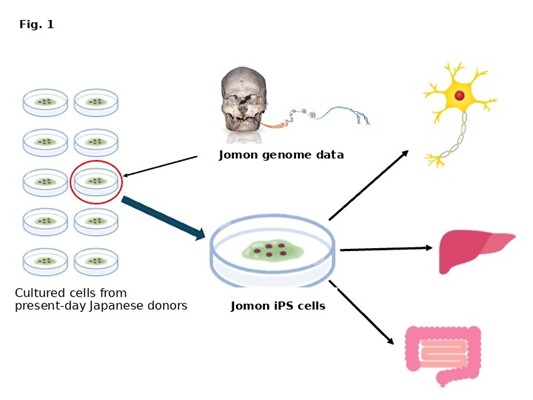
Selecting cells from present-day Japanese donors based on the degree of Jomon ancestry in their genomes and establishing iPS cell lines.
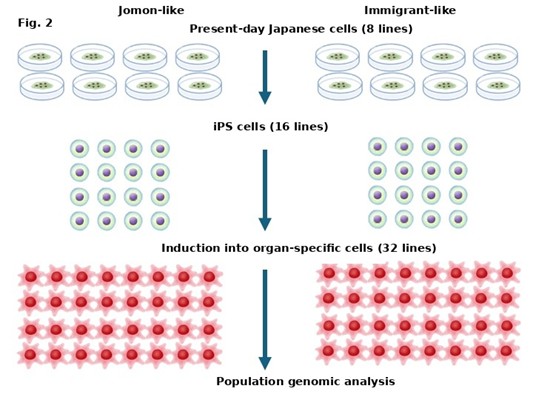
Developing population-genetic analyses using Jomon iPS cells.
The Central Question of This Research
The essence of our interest is to answer the question: “To what kinds of environments had the Jomon adapted evolutionarily?” At the same time, the research outcomes and the research system developed through this project can be transferred to foundational technologies for personalized medicine.
Learning about people of the ancient past also leads to deeper understanding ourselves today. This project is a basic research endeavor that approaches the physiology and genetic makeup of the Jomon, while also serving as a challenge to build a research foundation for understanding individual differences in the constitution of present-day Japanese people and supporting future personalized medicine, preventive medicine, and health science.
Why Donations Are Needed
This research began as basic science driven by a very simple question in the natural sciences: we want to understand the constitution of the Jomon through genome science and iPS cell technology. It is not research aimed at short-term gains. Rather, it seeks to bring together important knowledge related to human history, the constitution of present-day Japanese people, and future foundations for medicine.
At the same time, genome analysis and iPS cell research require expensive reagents, facilities for the long-term maintenance and management of cells, and computational environments for analyzing large volumes of data. Training young researchers with advanced technical skills is also essential for reliably advancing cell culture, differentiation induction, and genomic analyses.
Public research grants are usually awarded in three- to five-year periods. To maintain cells over the long term, pass on technical expertise, and develop the research further, continuous and flexible financial support is necessary. For this reason, we are seeking donations from those who support this vital research project.
Main Uses of Donations
・Purchasing reagents and consumables needed for genome analysis and cell culture.
・Developing a research environment for the long-term maintenance and management of iPS cells and differentiated hepatocytes.
・Establishing computational environments, including large-scale computers, needed for genomic-data analysis.
・Training and employing young researchers who will carry out cell culture, genome analysis, and data analysis.
Donations will be used carefully not only for the expenses needed for experiments and analyses, but also to train the people who will advance the research and to create a secure environment in which they can successfully conduct research.
Expected Outcomes
By moving this project forward, we aim to establish a new research system for understanding the adaptive evolution of the Jomon at the cellular level. Specifically, by generating iPS cells from cells with high proportions of Jomon genome segments and inducing them to differentiate into hepatocytes, we will build a Jomon-like hepatocyte system. This will enable statistical analyses that reflect the diversity of actual human populations.
We will also compare Jomon-like hepatocytes with present-day Japanese hepatocytes and analyze responses to drugs, metabolic functions, and responses to infection and inflammation. By accumulating the resulting data and combining them with data-analysis technologies, including AI, we will build a foundation for understanding how genomic individual differences are related to cellular functions and physiological traits.
Broader Social Impact
Until now, iPS cells have mainly been expected to contribute to regenerative medicine. In addition to this, we propose a path for using iPS cells as an experimental platform for understanding genomic individual differences. By building a research system for population genetics using cells, we aim to achieve a more quantitative and statistical understanding of differences in constitution that could not be sufficiently explained by conventional genetic testing alone.
Research into the constitution of the Jomon is not research only for knowing the past. It is research that connects ancient genomes to an understanding of the constitution of present-day Japanese people and to foundational technologies that will support future personalized medicine, preventive medicine, and health science. Your support would be greatly appreciated.
Ethical Review
This research is being conducted as a study approved through the ethical review process of the University of Tokyo (Review No. E2025ALS330; research title: “Population Genomic Analysis of the Dispersal and Adaptation of Modern Humans (8)”).
Interview Articles
Related Links
Acknowledgment and Gifts for Donations
The acknowledgments and gifts of the University of Tokyo Foundation apply to this project.
Project-specific acknowledgments and gifts are as follows.
| Donation tier | Acknowledgments / gifts |
|---|---|
| JPY 30,000 or more (one-time donation) | • Membership card for the “Jomon iPS Cell Supporter Club”. • Name listed in the acknowledgments section of related academic presentation slides (upon request). |
| JPY 100,000 or more (one-time donation) | • In addition to the above: a copy of Hiroki Oota’s book Sapiens History as Seen through Ancient Genomes (Yoshikawa Kobunkan). |
| JPY 300,000 or more (one-time donation) | • In addition to the above: invitation to an Annual Meeting hosted by the laboratory. |
| JPY 500,000 or more (one-time donation) | • In addition to the above: right to give a nickname to a Jomon iPS cell line; special membership card with a photograph of the named cell. • First-year limited offer: genetic-type survey for “strong or weak alcohol tolerance”. |
| JPY 1,000,000 or more (one-time donation) | • In addition to the above: name listed as a “Fund provider” in research-outcome papers. • First-year limited offer: survey of the degree of Jomon ancestry in the genome. |
Note: Shipment of acknowledgments and gifts is scheduled to begin around November 2026.
Note: Membership cards, special membership cards, and books are limited to one item per person.
Note: For iPS cell nicknames, consultation may be needed depending on the proposed name.
Note: Applications for the genetic-type survey and the survey of the degree of Jomon ancestry in the genome are accepted through March 31, 2027. These surveys are planned to be offered upon request during attendance at the Annual Meeting, held once a year.